Background and General Introduction
The enclosure of open fields and commons had been going on quietly and slowly in many parishes in England in the 15th and 16th centuries, if not before. These enclosures were either achieved by informal agreement between landowners, or by formal agreements ratified in a court of law. In Tysoe these types of enclosure are described in the documents which are the subject of this study as ‘Old Inclosures’ or ‘Ancient Inclosures’. They are to be found over much of the parish north of the A422, around Hardwick Farm, Brixfield Farm and Upper and Lower Westcote, as well as in isolated pockets elsewhere.
But by the end of the 18th century the remainder of the land in the parish remained unenclosed in open fields, commons, wastes and meadows. While we can infer some information from our existing study of field names and the evidence of ridge and furrow in fields around the village, we now have documentary evidence of the pre-enclosure layout of Tysoe. The following photograph is just one of 20 map extracts showing the Earl of Northampton’s Estate as it was in 1770. It shows the density of the strips in the open fields and parts of the common land. There is much work still to do based on this source.
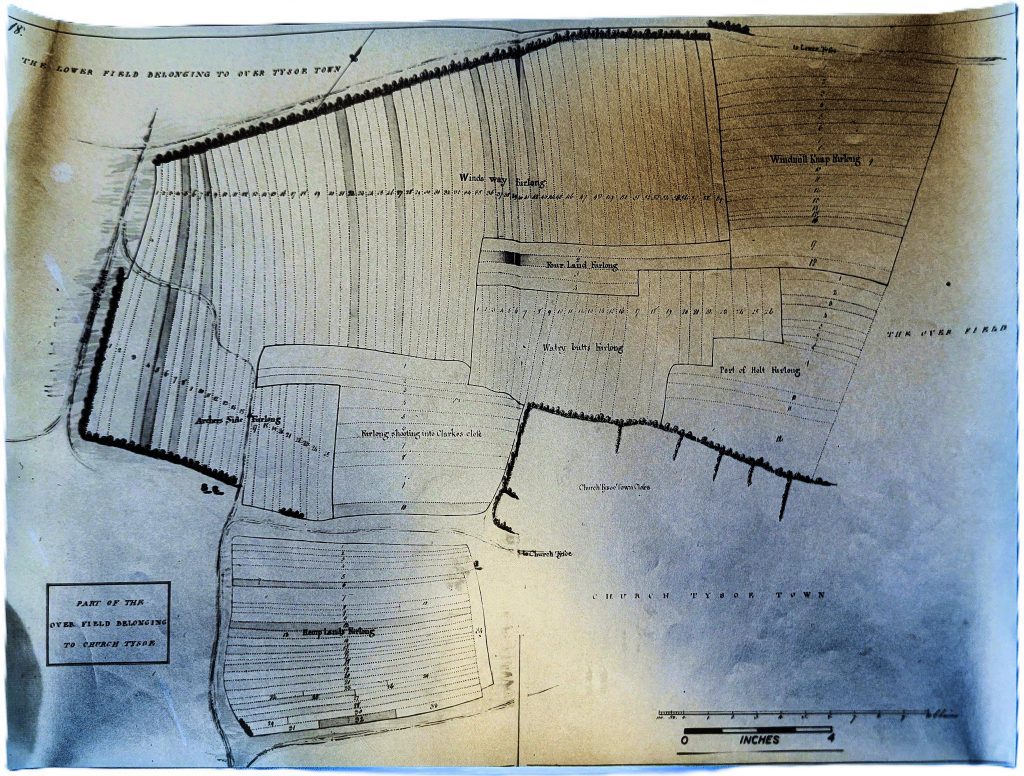
Lord Northampton Estate c1770
For the time being, this study focuses on the enclosures which followed the private Act of Parliament known as the Tysoe Inclosure Act 1796. Enclosure by Act of Parliament was occurring throughout the Midlands during the 18th century, and it is Parliamentary enclosure that we usually have in mind when we recognise changes to the landscape brought about by the planting of hedges around parcels of land and the existence of unusually straight roads.
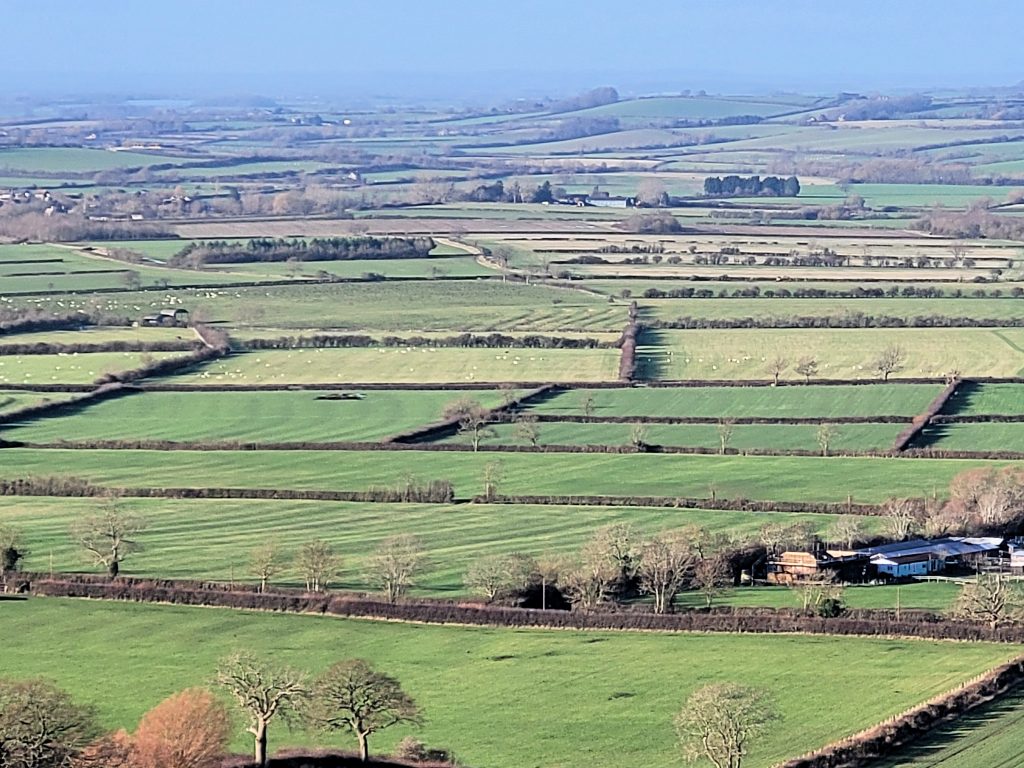
View from Sun Rising hill of post-enclosure fields
But its far less visible consequences were at least as important, as agricultural production was, in effect, revolutionized. Prior to enclosure, “farms” would have comprised strips of arable land, sometimes as many as 50, distributed throughout the open unfenced fields. They had to be farmed in accordance with the decisions made annually by the Court Leet (qv) or manorial court. So ‘farmers’ had to sow crops in rotation, including a fallow period, and graze animals at agreed times of the year and in agreed places. In addition, the use of the common land, whether for grazing, fuel gathering, or cutting of turf was similarly governed by strict rights held by individuals. The origin of those rights was often obscure.
Finally, proprietors and tenants of land and some of those with common rights or strips in the arable fields paid tithes to the vicar or rector of the parish for the support of the clergy and church, or to a lay person. Thus every man or producer had to farm in concert with his neighbours, and many, in exercising their common rights, relied to some extent on the use of land not his own. In other words, agricultural production had to be managed communally and co-operatively.
Although we have not yet studied the pre-enclosure layout of Tysoe’s open fields and commons, we can look elsewhere for enlightenment.
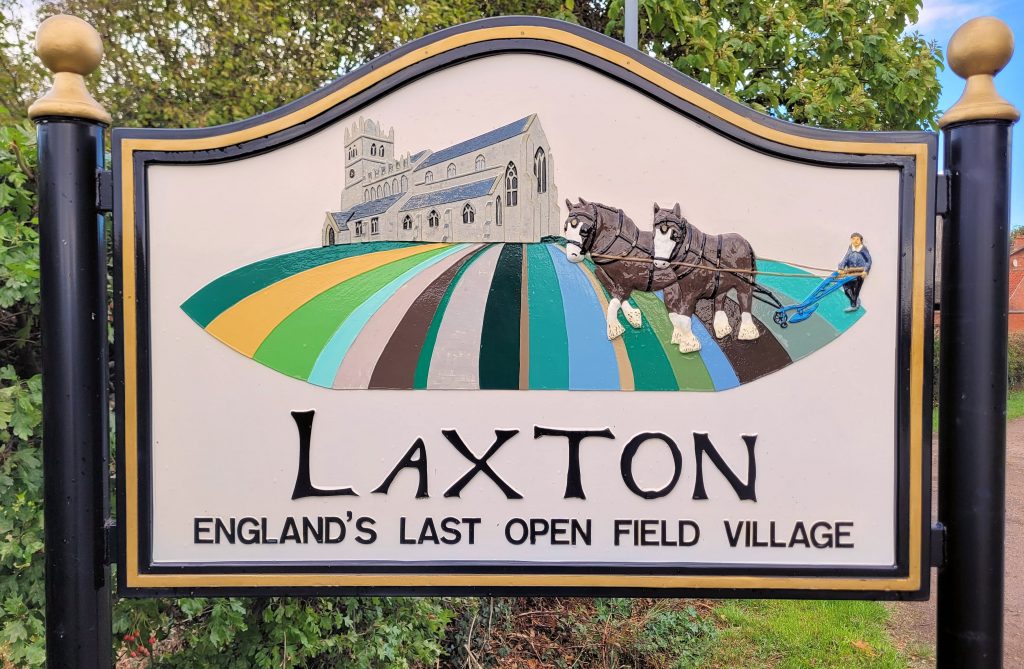
Laxton village sign board
Laxton in Nottinghamshire claims to be the only parish in England in which the open-field system survives, albeit slightly modified in the early 20th century, when some of the original narrow strips (or yardlands qv) were consolidated to allow the use of contemporary machinery.
A map of Laxton made by Mark Pierce in 1635 shows the arrangement of strips in part of the parish.
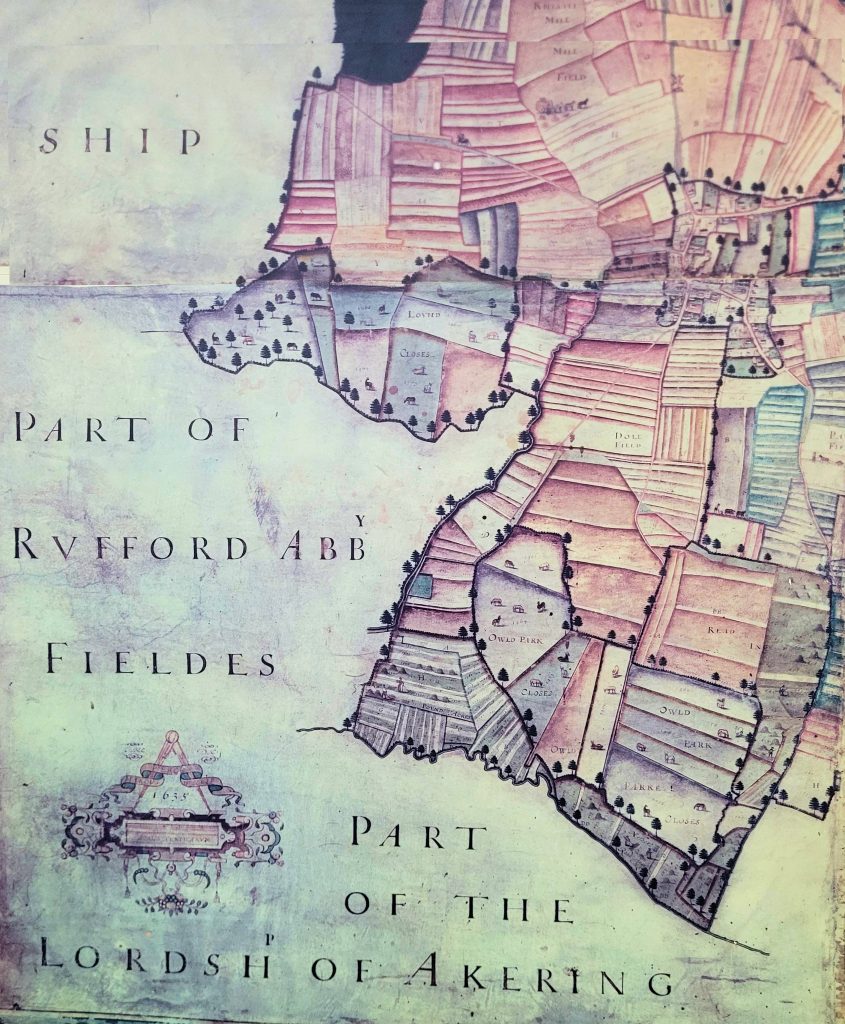
A map of Laxton made by Mark Pierce in 1635 shows the arrangement of strips in part of the parish
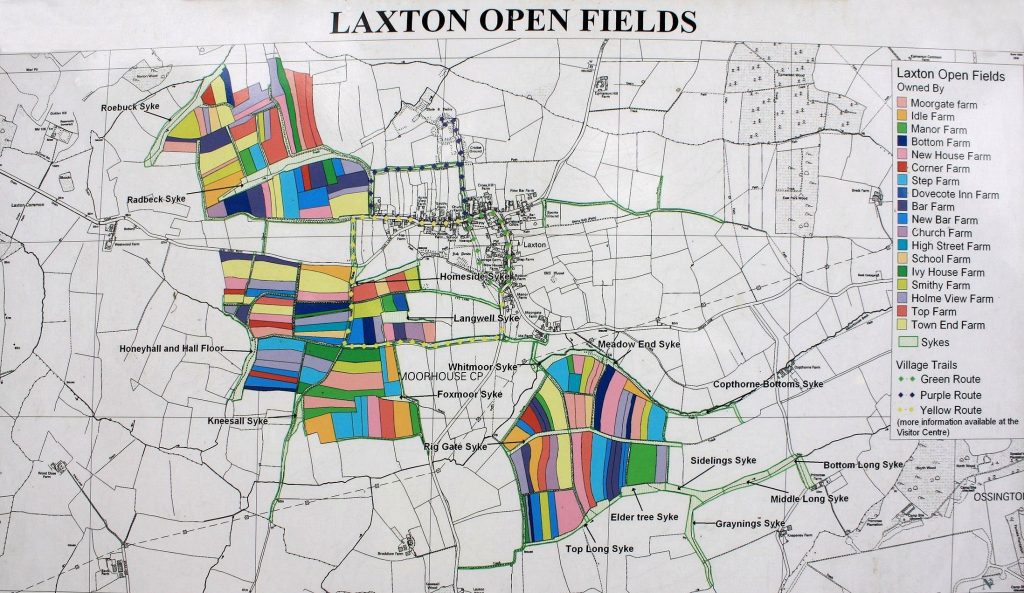
The Village Visitor Centre has a modern interpretation of the original open field system
The Court Leet (qv) in Laxton still exists and farmers there still meet to decide the course of husbandry in the open fields, and then work co-operatively to farm the land. It is noticeable that all the farmsteads are still within the village, as there has been no incentive to move the farmhouse and buildings out of the village to privately owned land at the centre of a consolidated holding.
It is probably safe to assume that pre-enclosure Tysoe would have resembled the pattern that can still be seen in Laxton. Indeed, we can still see some farmsteads, such as Mill Farm and Herberts Farm, in the centre of the three townships that comprise modern Tysoe.
So who owned the commons, open fields and other land in a pre-enclosure parish, such as Tysoe? The Lord of the Manor, either resident locally or an absentee landlord, nominally owned the soil of the Manor. Other ‘farmers’, either gentleman farmers or yeomen, held land either as freeholders or copyholders (qv). Cottagers (qv) were usually tenants of these landholders.
But discrete groups did not necessarily exist and it is difficult to disentangle the range of land tenures and social strata, as boundaries between them are often blurred. Many farmers held both freehold and copyhold land. Some commoners with a right of pasture on the common might also have held strips in the open arable fields. Any of these ‘proprietors’ may also have been required to pay or were entitled to receive tithes.
One historian (J A Martin) has argued that, in the Feldon, even where men did not occupy any open field strips, they might still obtain a high proportion of their income from the land because of the prevalence of customary rights of usage of the common and waste, the remainder of their income being made up by day-labouring or a trade such as shoe-making. So even landless men had a vested interest in the process of enclosure and what it would mean to them.
It was often argued in the 18th and 19th centuries that the process of enclosure presented the opportunity to improve agricultural productivity, since the consolidation of ownerships could, for instance, allow for drainage improvements, and the planting of hedges could allow controlled stock breeding. Enclosure could, and usually did, result in the commutation of tithes, as those entitled to receive tithes were compensated by the allocation of freehold land. Boundary disputes could be settled once and for all, as could matters of unauthorized encroachment on common land. All these matters have, at some time or other, been cited as positive outcomes of enclosure.
However, historians, with few exceptions, agree that the driving force behind a move to enclose land was a desire by the land-owning classes to gain full control over a block of land which could generate more income when managed more efficiently than the open field system allowed.
The hedges and fences that followed from enclosure brought important physical changes to the landscape but the most important effect on the social fabric of the parish arose from the disappearance of community-based working and production, and the establishment of a system which made it possible to farm land in ‘severalty’ (qv) meaning independent of other farmers. Some historians have described this as the ‘privatisation of farming’.
How was Enclosure achieved?
Against that background, we can move to the specific process which transformed the landscape and social fabric of Tysoe at the turn of the 19th century. The process by which enclosure was achieved produced three important documents. We are fortunate that all three documents, described below, are kept in the Warwickshire County Record Office. Elsewhere research is hampered by the loss of one or more of these sources.
The process of achieving the enclosure of a parish began with an Act of Parliament, which in Tysoe’s case was passed in 1796, when George III was on the throne. That Act is the subject of this first paper of the series. Further papers dealing with the subsequent documents will follow in due course.
The second important document was the Commissioners Minute Book which was kept by the Clerk to the Commissioners (usually a local solicitor). The Commissioners were the decision-makers. They decided how the land to be enclosed should be apportioned between those who owned strips in the open fields, enjoyed rights of common usage, or needed to be compensated for loss of tithes by acquiring productive land by way of compensation. The Minute Book records the meetings at which such decisions were taken and contains the accounts recording the costs involved in implementing the Commissioners decisions.
The third important document was the Inclosure Award in which the Commissioners set out their decisions and their plan for the parish. This was usually accompanied by a corresponding Inclosure Map, prepared by the surveyors appointed by the Act and working under the direction of the Commissioners, showing the new enclosures or fields.
In Warwickshire, the first few Acts of Inclosure were passed in the 1720s and 1730s, but the majority passed between 1750 and 1779. The Tysoe Inclosure Award and Map followed slightly later in 1798, so between the passing of the Act and the completion of the Inclosure Award two years elapsed, during which time the Commissioners had the power to direct the course of husbandry that all proprietors should follow. What follows is a summary of the legislation that governed the implementation of enclosure in Tysoe.
The Tysoe Inclosure Act 1796
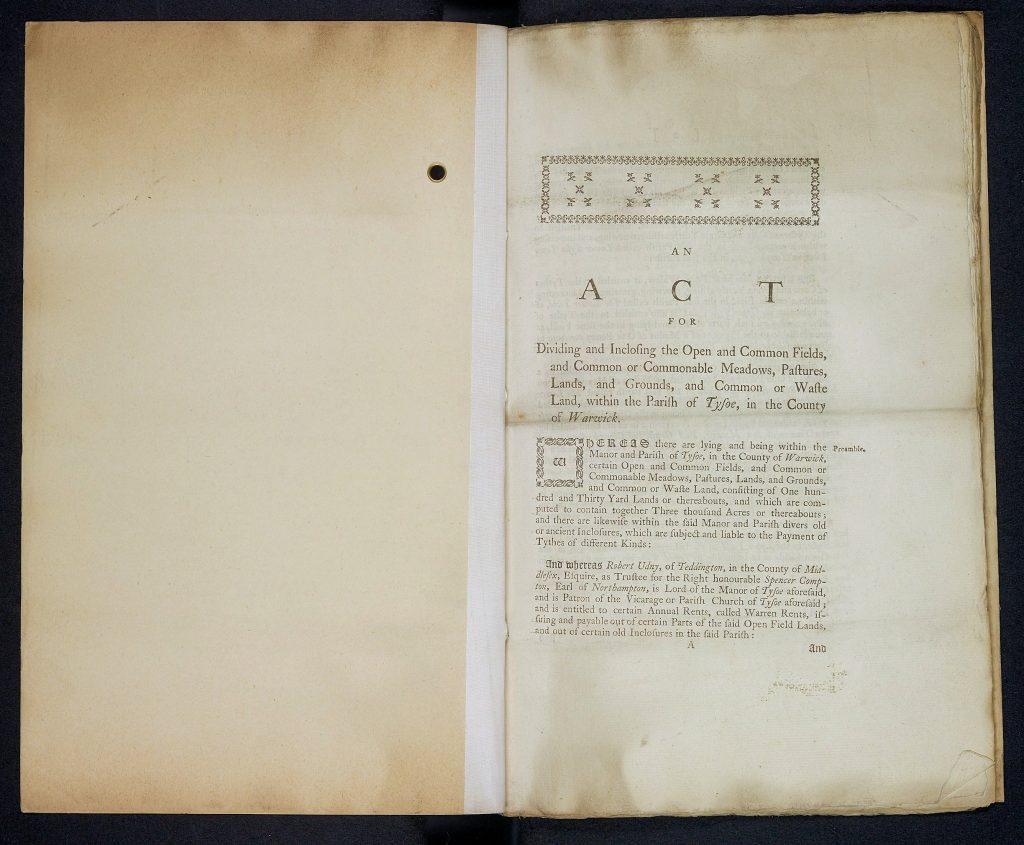
The Tysoe Inclosure Act 1796. Page 1
The 18th century was characterized by a set of circumstances that precipitated a surge in the number of Inclosure Acts, which were the first move in the enclosure of any parish. These joint pressures were a rising population; a desire for greater efficiency in agricultural production; and rising prices for food and wool. Enclosure by Act of Parliament peaked in the late 1770s and generated a new professional body of ‘enclosers’ headed by the commissioners who were (nominally) appointed by Parliament to oversee “the demise of the open fields, wastes, heaths, commons, fens and moorlands.” They relied heavily on Surveyors who surveyed the parish at the outset to establish how much land was to be enclosed and who also eventually produced for the Commissioners the final map showing the “allotments” that were “awarded” to the beneficiaries of the process.
By 1770, the format of the Bills presented to Parliament had become fairly standardised, and the wording of the Tysoe Act shares common wording with others described in the literature. This had the obvious advantage of keeping down the costs of bringing a Bill to Parliament, and there was a good deal of sense in using ‘tried and tested’ wording.
The first paragraphs of the Tysoe Act set out its purpose. So we see that it is “an Act for Dividing and inclosing the Open and Common Fields, and Common and Commonable Meadows, Pastures, Lands, and Grounds and Common or Waste Land within the Parish of Tysoe in the county of Warwick”. The introduction to the Act notes that there are about “130 yardlands (qv) or thereabouts” comprising 3000 acres “or thereabouts”.
Then the Act implicitly reveals the ‘pecking order’ of the social strata in the parish, beginning with those proprietors who had a significant and direct interest in the outcome of the enclosure process. The named key personalities were the Lord of the Manor (or his Trustee) with other proprietors following in descending order of social standing, together with John Seagrave, the vicar at the time.
Robert Udny of Teddington Middlesex Esq is named as the “Trustee of the Rt Hon Spencer Compton, Earl of Northampton, who is Lord of the Manor and Patron of the Vicarage or Parish Church, and entitled to certain Annual rents called Warren rents (qv) issuing and payable out of certain parts of the said Open Field Lands and of certain Old Inclosures in the parish”.
Robert Udny (1725-1802) was married to Mary Hougham, whose sister was the wife of Spencer Compton, Earl of Northampton. Udny was a Scottish merchant, art collector, Fellow of the Royal Society, and owner of a sugar plantation in Grenada.
The Trustees of Robert Child, Esq are entitled to “tythes of corn, grain and hay ….from the Upper Field of Church Tysoe”. Robert Child (1739-1782) was a banker and politician, who was MP for Wells from 1765 until his death. He disinherited his only daughter to prevent his fortune falling into the hands of her husband, the 10th Earl of Westmoreland. Eventually his estate, which included Osterley Park in London, passed to his grand-daughter, who married George Child Villiers, 5th Earl of Jersey. We know that the Earl of Jersey held land in Tysoe in 1819 and this is an avenue for future research.
Margaret Price, Widow is entitled to “tythes of corn and grain from the Lower Field of Upper Tysoe…. and a “tythe of hay” from the same field. At the time of writing, little is known about her.
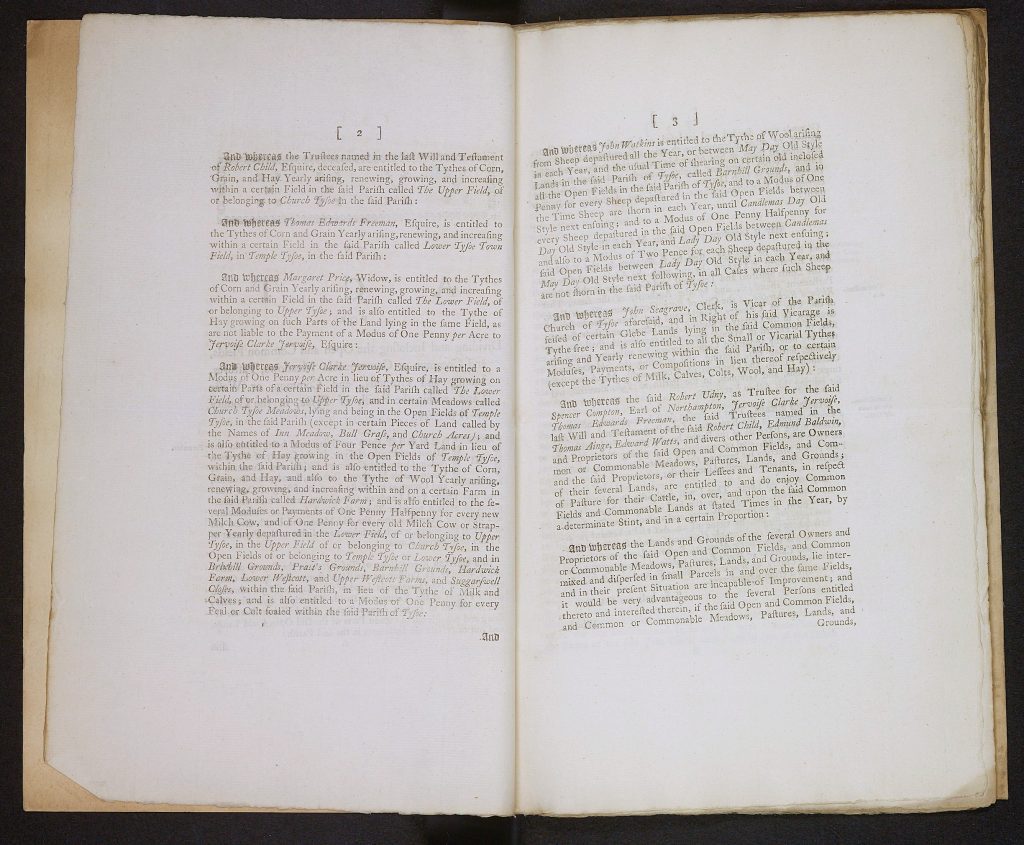
The Tysoe Inclosure Act 1796. Pages 2-3
Jervoise Clarke Jervoise is entitled to a “Modus (qv) of one penny from part of the Lower Field of Upper Tysoe… and in certain meadows called “Church Tysoe Meadows being in the open field of Temple Tysoe [now known as Lower Tysoe] except certain meadows…called Inn Meadow, Bull Grass and Church Acres”.
The list of tithes payable to Jervoise Clarke Jervoise is far too lengthy and detailed to reproduce here. But, briefly there are interesting references to a tithe of wool from Hardwick Farm; tithes payable for every “milch cow or strapper yearly (de)pastured” in various fields including Barnhill Grounds (now known as Kirby Farm near the Oxhill parish boundary); Brixhill Grounds, Lower and Upper Westcott Farms (on Radway Road) and Sugarswell Closes (on Sugarswell Lane) and so on.
Jervoise Clarke Jervoise (1734-1808), whose family home was at Idsworth Park in Hampshire, was an English Whig MP who sat in the House of Commons for most of the years from 1768 as MP for Yarmouth, Isle of Wight until his death. During that time he made no contribution to Parliament according to Hansard. However, the passage of the Act would have been conducted in Committee, and there are no records of Committee proceedings during this period.
However, it is not unreasonable to assume that like other great country landowners, packing the relevant Committee with friends or relatives was common practice and may well have occurred when the Tysoe Act was under consideration as a local example illustrates.
Sanderson Miller’s interest and skill in architecture produced an extensive network of social and political contacts, including the Marquis of Hertford and even William Pitt the Younger who could be called on, if not in person then via other contacts, to serve on the Committee when the Bill for the Radway Inclosure Act was going through Parliament in 1757.
John Watkins about whom we know nothing at present was entitled to tithes of wool pastured on “certain Old inclosed fields called Barnhill Grounds and in all the open fields of the parish”.
John Seagrave (Vicar) is “seized of certain glebe lands lying in the common fields, tythe free” and is also entitled to “all the small or vicarial tythes (qv) arising and yearly renewing the parish, and to certain Moduses (qv) …. in lieu thereof”.
And finally, “Robert Udny as Trustee of the Earl of Northampton, Jervoise Clarke Jervoise, Thomas Edwards Freeman, the Trustees of Robert Child, Edmund Baldwin, Thomas Ainge, Edward Watts and divers other persons” are “owners and proprietors of the open and common fields, and common or commonable meadows, pastures, lands, and grounds, and the said proprietors or their lessees or tenants are entitled to enjoy common of pasture for their cattle at stated time of the year by a determinate stint (qv) and in a certain proportion.”
Having concluded the roll call of the principal landowners and recipients of tithes, the Act states the purpose of the enclosure as follows:
“Whereas the Lands and Grounds of the several owners and proprietors…lie intermixed and dispersed in small parcels, and in their present situation are incapable of improvement; and it would be very advantageous to these several persons entitled therein, if the lands and grounds…were divided and inclosed and specific parts or shares thereof or other recompense therein, assigned and allotted unto and amongst them in lieu of and in proportion to their respective lands, tythes, commons right and interests…………….. “ May it therefore be enacted………”.
The Act then identifies the Commissioners to be appointed, although as will be seen below, they may be placemen of the major landowners. They are Richard Richardson of Bath, Thomas Eagle of Coventry and John Chamberlin of Cropredy. The form of oaths to be taken by the Commissioners is set out in the Act and requires them to act without fear or favour and to the best of their judgement.
The Act sets out how replacement Commissioners should be appointed should the need arise, which almost certainly sheds light on the appointment procedure. If Richard Richardson should die, his replacement should be chosen by Robert Udny, Trustee of the Earl of Northampton. If Thomas Eagle should die, his replacement should be chosen by Thomas Edwards Freeman and the Vicar “together with the major part in value of the several owners and proprietors of Great (qv) and Small Tythes (qv) arising in the Parish”. If John Chamberlin should die, his successor should be chosen by Jervoise Clarke Jervoise and “the major part in value of the owners and proprietors of lands and grounds in Temple Tysoe”. It may be inferred that the main proprietors had nominated the appointed Commissioners in the first place and that their appointment was simply rubber-stamped by Parliament.
The Act then addresses matters of procedure.
- Although three commissioners are appointed, any two may act.
- The formalities of giving notice of meetings include a notice in the Oxford Journal and another pinned to the Church Door 8 days in advance.
- If only one Commissioner turns up, the meeting is adjourned and arrangements must be made to meet again within 30 days and no meeting is to take place more than 10 miles from the parish.
- The Commissioners are required as soon as possible after the passing of the Act to “view, value and appraise” all the land to be divided and enclosed. The valuation is to be put in writing and may be inspected by interested persons who are entitled to a copy (subject to paying a “reasonable price”).
- A “true and perfect survey and admeasurement shall be made of all the land to be divided and inclosed, and also of all the homesteads, Ancient Inclosures and estates and the several townships, hamlets and places lying within the same as are to be exonerated and discharged of tythes”.
- The Commissioners are empowered to enquire into encroachments which have been made upon the land and grounds to be enclosed (unless such encroachment had been enjoyed for 20 years without interruption).
- The Commissioners may direct the course of husbandry to be followed on the land to be enclosed until the Inclosure Award is executed. Failure to comply may be subject to a fine of £5 per acre. Failure to pay may result in goods and chattels being distrained.
James Jennings of Somerton (near Bicester) and Stephen Godson of Brailes are appointed Surveyors and given power to enter land to discharge their duties. In practice, Stephen Godson surveyed Church and Upper Tysoe and James Jennings surveyed Lower Tysoe and land north of the turnpike (now the A422).
The Act specifies the duties of the Commissioners, and in effect the order in which they are to proceed. The first of these is to set out public roads, bridleways and footways, private carriage roads and driftways (qv).
“They are required to ascertain set out and appoint both public and private roads and highways through and over the new allotments and enclosures with the assizes and breadth so that all public roads shall be and remain 40 feet broad at the least between ditches….. When marked and set out notice shall be given in the Oxford Journal of the day when the commissioners must receive any objections.”
When the public roads have been set out as described they must be fenced on both sides by the owners and proprietors of the adjoining land (except the Vicar). The Act specifies that it is unlawful to erect any gates across them, or to plant any trees in the hedges alongside any public road at a distance of less than 50 yards from each other. (One historian has suggested that this is to prevent the creation of any hiding places where highwaymen might loiter). The Commissioners are also empowered to set out where bridle ways, footpaths and ‘private carriage roads’ will run and specifies their dimensions and in the latter case the restricted number of individuals who acquire a right to use them.
The Commissioners are then to appoint a surveyor who will put the roads “into good repair”. and the work is to be done within two years from the date of the Inclosure Award. The surveyor’s costs and salary have to be borne by the adjoining landowners (except the vicar). The soil of the public roads is vested in the Lord of the Manor, but the Commissioners can award the herbage growing in the roads to other persons.
Further details relating to the fencing or hedging of bridleways are specified to prevent sheep and cattle doing damage to “banks, woods, plants, quicksets (qv) and fences”
Then follows the order in which the Commissioners are to identify land to be enclosed and allotted to individuals or for other purposes.
They are firstly to identify one or more pieces of land not exceeding 9 acres in total “most convenient for the getting of stone and gravel” for repairing the roads.
Then they must identify land to award or allot to the Lord of the Manor “in lieu of warren rents (qv)”.
Subject to any claim being made on behalf of the poor of a right of cutting “furze or goss” (qv), they are empowered to award land (not exceeding 18 acres) to the Earl of Northampton to be held in trust for this purpose. The furze is to be cut annually under the supervision of the Minister, Churchwardens and Overseers of the Poor. Infringement of their orders may result in arrest and upon conviction, time spent “in the common goal or House of Correction for one month”.
Next the Commissioners must make allotments to the owners of Great Tythes, viz the Trustees of Robert Child et al. (see above).
Then they are to make an award to John Seagrave (Vicar) in compensation for the Glebe land and in lieu of Vicarial tythes (qv). The Act then lists a variety of properties, including cottages, farmhouses, windmills, orchards, and gardens which are subject to the payment of tithes to the Vicar. In order to “exonerate and forever discharge” these properties from the payment of such tithes, “the Commissioners shall take from the open fields, such parcels and quantities of land which they adjudge to be equal to the value of the tythes” and add them to the new parcels awarded to John Seagrave.
Next the Commissioners are to deal with the compensation in the form of land to be awarded to Jervoise Clarke Jervoise, John Watkins, the Trustees of Robert Child, Thomas Edwards Freeman and Margaret Price, in lieu of moduses (qv) or tithes (other than Great Tithes for which see above).
It is clear that the preceding instructions to the Commissioners are to take precedence in their deliberations as the following clauses deal with the “residue of the land to be inclosed”.
[In the interests of brevity I shall refer to these unnamed beneficiaries of Awards as ‘secondary recipients’.]
In making awards, they must have regard to the “quality, quantity and situation and convenience of the land” to be awarded. Claims for such awards must be submitted in writing to the Commissioners at their first or second meeting. If any disputes arise, the Commissioners may take evidence on oath. Their decision will be “binding and conclusive to all parties”, subject only to recourse to a court of law. Clearly, this recourse would not be an avenue open to the poor and possibly landless of the parish who may have been dependent on their customary common rights.
[Part 2 of this study (to follow) which will examine the Minute Book of the Proceedings of the Commissioners will show how the Commissioners exercised their powers in respect of the foregoing matters involving the allotment or awarding of land to bring about the enclosure of what had previously been open fields, common land or waste.]
The Act then specifies further details of matters which the Commissioners are empowered to address. For instance they may divert springs and watercourses and we shall see how they do so in the 1798 Inclosure Award which will comprise Part 3 of this study).
They must determine how the land awarded to the principal landowners is to be “inclosed with quickset hedges and ditches, sufficiently guarded with substantial posts and rails” paid for by the ‘non-principal recipients’ of allotments and maintained by them for a period of 7 years, whereupon the owners of the land so enclosed become responsible for maintaining their own fences and hedges in perpetuity.
There are very detailed provisions about the way in which the quickset hedges around the allotments awarded to ‘non-principal recipients’ must be protected by fences or trenches for a period of 8 years from the execution of the Award. They are to “set down posts and rails, or other fences and to make trenches commonly called underbanking, or trenches on the outside of the ditches bounding their respective allotments, not exceeding three feet from such ditches for the better preservation of the hedges”. The remedies for refusing to fence are severe, but do not apply to the ‘principal landowners’ or the vicar.
On any lands in the open and common fields, “upon which any trees, woods, shrubs, underwoods, thorns, hedges, bushes and furzes” are standing at the time of the Award and which are allotted to other proprietors, the original owners may enter the land within a year of the Award to fell the above-mentioned growth for their own use and then level the ground. However, any fences or young trees standing on any land to be enclosed must not, between the passing of the Act and execution of the Award, be cut down without the express consent of the Commissioners.
Anyone to whom an allotment or award is made must formally accept his award within one year, and anyone who fails to do so “shall be totally excluded from receiving any estate, interest, right of common or other property”, provided that guardians, husbands, trustees and similar may accept allotments awarded to “minors, lunatics, those beyond the seas or otherwise incapable of accepting their allotments”.
If proprietors of land allotted to them have not “inclosed, hedged, ditched and fenced their parcel within the time appointed by the Commissioners” adjoining owners may lodge a complaint in writing to a JP who can direct the enclosure to be effected. Severe penalties for non-compliance are imposed including seizure of goods and chattels.
Furthermore, the Act forbids the keeping of sheep or lambs for a period of 7 years from the date of the Award on any land adjoining the ring-fence of another person’s allotment unless the owner of the livestock has created “guard mounds with thorns in so effectual a manner as to prevent their getting through and injuring the quick”.
The Act makes provision for the “more convenient situation and disposition of farms and lands of the respective owners” for John Seagrave (Vicar) to exchange all his land in the parish of Tysoe for any other land in the parish or in any adjoining parish. We shall see in Part 3 relating to the Inclosure Award that the Commissioners authorized such an exchange between the Earl of Northampton and John Seagrave involving land in the parish of Whatcote but see Appendix 1 of this document for detailed correspondence on the subject.
The Act contains many detailed provisions concerning financial matters such as the termination of leases; the power of land owners to borrow money to meet the costs of implementing the Award and so on. These demonstrate how the costs associated with enclosure were apportioned between beneficiaries by the Commissioners and the complexity of the process which they undertook.
The Act prescribes the detail to be included in the Award. The Commissioners are required to set out the acreage of the land to be enclosed; a description of its boundaries; and the orders for the making and laying out of public and private roads and other routes. The Award was to be kept in the Parish Chest in the church.
All the expenses of the Act incurred in the entire process from obtaining the Act to the allotting of the land, and of ring-fencing the land awarded to John Seagrave “and all other necessary charges of the Commissioners and the persons employed by them shall be paid by the persons allotted land (except John Seagrave) in such proportions as the Commissioners shall direct” and payment shall be made within 10 days of a notice to the effect being posted on the church door. The Commissioners are to be paid £2 and 2 shillings for every day that they are employed (including travel). In Part 2, relating to the Commissioners Minute Book, we shall see the scrupulous accounts that were kept by the Clerks.
Conclusions
The Act runs to over fifty closely printed pages and much of the detail has, of necessity, been omitted from this commentary. The Act clearly prescribed the order in which the Commissioners should approach their deliberations, and discharge their duties. The complexity of their task should not be underestimated. The Act received Royal Assent on 24th March 1796 and the Inclosure Award was executed on 17th January 1798. That the Commissioners accomplished what they did in between those dates is remarkable, but that two year period must have brought huge uncertainty to the farming community at all levels of society.
The enclosure of the parish involved the complete upheaval of the landscape of the parish; a seismic shift in the organisation of agricultural production; and a permanent impact on the social order as experienced by both the great landowners, and, at the other end of the spectrum, those already struggling to make a living.
This is not the place to summarise the landscape effects which will follow in Part 3 of this study, but the Act is interesting for its detailed requirements regarding the establishment of routeways and planting of hedges. Further work on the post- enclosure effects on agricultural production may well be circumscribed by the paucity of facts available about pre-enclosure production levels. These present conclusions therefore focus on the way in which the Act is revealing in terms of its intrinsic top-down approach to enclosure.
The process by which the Tysoe Commissioners were appointed by Parliament remains rather obscure, but the manner in which the appointment of replacement Commissioners was specified is telling. The principal beneficiaries of the Act and Award were almost certainly those who held the largest landholdings and entitlement to tithes. The special treatment accorded to them and to John Seagrave, the Vicar, is noticeable throughout Act. The Vicar is exempted from carrying a proportionate burden of the costs of securing the Act and implementing the Award, and he achieves a more convenient and advantageous parcel of land following the exchange with the Earl of Northampton’s land in Whatcote.
Some of the small landowners, and many of the poor and landless would have been disadvantaged by the need to make claims for allotments of enclosed land in writing to the Commissioners and the latter group receive scant consideration in the ‘design’ of the post-enclosure parish. A clause states that all common rights are to be extinguished and many of those partially or wholly dependent upon such rights were not compensated by allotments of land.
Legal notices printed in the Oxford Journal would have been inaccessible to many, although notices pinned on the Church Door would have been a reasonable substitute (for those who were literate). The possibility that Commissioners meetings could be held up to 10 miles from the parish might have caused hardship for some. The penalties for non-compliance with the rules for cutting furze or gorse set by the ‘overseers’ seem particularly harsh for those who had hitherto been accustomed to cut fuel as and when their customary rights allowed.
The Act envisaged that some of those awarded land may need to borrow money to pay their share of the costs and charges associated with the Act and its implementation. But with only 10 days notice of an obligation to thus contribute, some small landowners may have been forced to sell their allotments to the principal landowners, who were intent at this time in increasing the extent of their holdings. Although a few provisions of the Act allow for recourse to law by way of challenge to the Commissioner’s decisions, many of their powers were absolute and, in any case, recourse to law would not have been a remedy available to any but the wealthy.
All in all, it is apparent that the Act of Inclosure imposed no explicit duty on the Commissioners to protect the rights who were dependent on common rights or were day labourers. This examination of the Act illustrates that from the outset the scales were tipped against the yeomen, poor and landless, and how those who already held most land, however dispersed and inconveniently located, stood to gain. To have a consolidated land holding with strong boundaries undoubtedly enabled the beneficiaries to farm more efficiently. However, one of the consequences was that a great deal of former arable land was turned over to grazing sheep, which produced more profit and required less labour, forcing the already disadvantaged off the land. The extent of ‘ridge and furrow’ in the grazing land around Tysoe is evidence of these changes and although we cannot currently quantify their effects, it is possible that further study of the Inclosure Award will shed more light on this subject.